



We’ve updated our Super Simple Service Agreement (SSSA).
Our Super Simple Service Agreement (SSSA) is the agreement that applies when you request or receive supports from us, unless we’ve agreed to use a different agreement with you.
It applies to most people we support. The SSSA is also our NDIS service agreement.
What this means for you
From 5 May 2026, a new version of our SSSA will apply to the supports we provide.
You can find our updated SSSA on our website at www.allianceclinics.com.au/sssa
You accept the updated SSSA by requesting or receiving supports from us on or after 5 May 2026, such as booking or attending appointments, accepting a quote, or asking us to complete work for you.
You don’t need to sign anything.
If anything in the updated SSSA is unclear, you can ask us to explain it at any time. You are not required to continue with supports if you don’t agree to it.
Change to caps
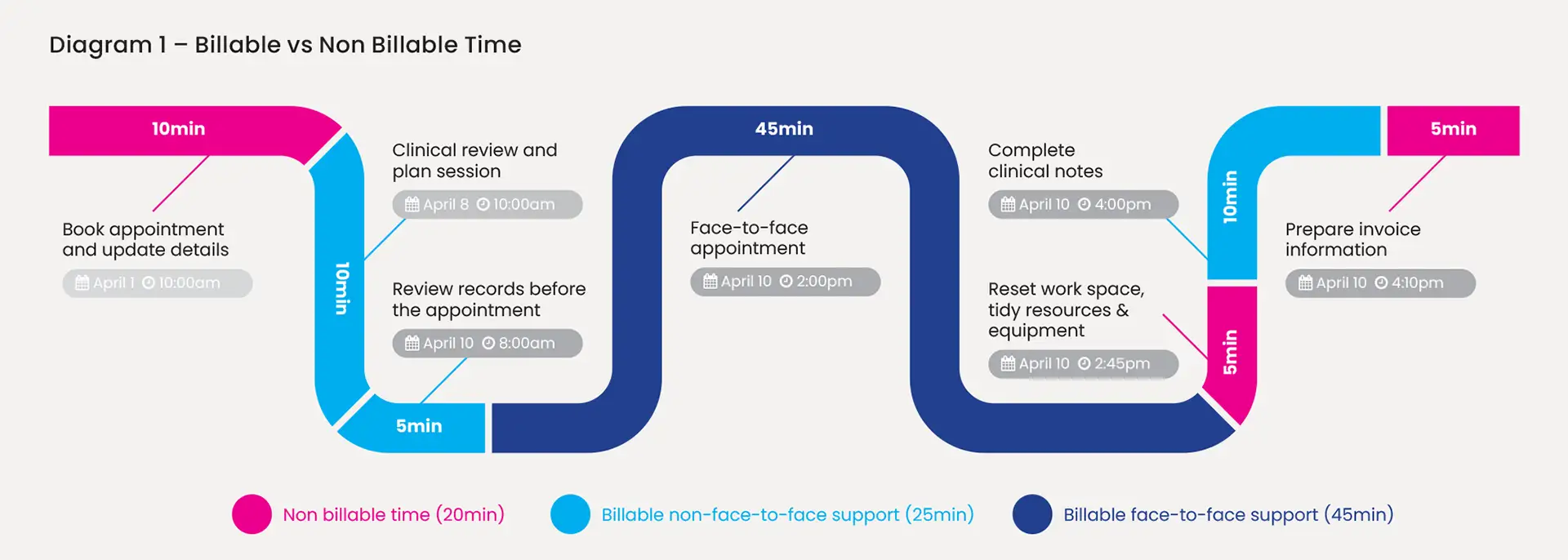
When you book an appointment with us, you’ve always booked more than just the time you spend directly with your clinician. Your supports include preparation before your appointment and follow-up afterwards, which are clinically necessary to deliver safe, effective, and tailored supports. This is not administrative work.
We call this preparation and follow-up, and it has always been billed.
Previously, we applied a voluntary cap of 15 minutes on how much preparation and follow-up time we would bill for a therapy appointment.
From 5 May 2026, this cap is increasing to 25 minutes.
This cap is something we chose to apply ourselves. Most providers do not apply a cap and instead bill for the full time required. Previously, this cap was an internal policy. It is now included in our service agreement to provide greater clarity and certainty.
Increasing the cap to 25 minutes better reflects the time typically required to deliver high-quality supports, while still maintaining a clear and predictable limit for therapy appointments.
This change is necessary for the sustainability of our service.
What changes for a typical therapy appointment?
For most participants, the total billed time for a typical therapy appointment will increase from 60 minutes to 70 minutes.
That total includes:
| Part of Support | Before | After |
|---|---|---|
| Face-to-face appointment time | 45 minutes | 45 minutes |
| Preparation & follow-up | capped at 15 minutes | capped at 25 minutes |
| Typical total billed time | 60 minutes | 70 minutes |
For example: For a speech pathology appointment, billed at $193.99 per hour, increasing the total time from 60 minutes to 70 minutes increases the cost of this appointment from $193.99 to $226.32.
How much preparation and follow-up time should I expect?
For appointments with 45 minutes or more of face-to-face time, you should expect they will typically require 25 minutes of preparation and follow-up time.
Both face-to-face time and any preparation and follow-up time spent supporting you may be billed as part of your supports.
Our cap means that you will not be billed for more than 25 minutes of preparation and follow-up for a therapy appointment unless we provide you with a higher estimate before booking, or you agree otherwise.
Will I always be billed for 25 minutes of preparation and follow-up?
No. However, you should expect 25 minutes of preparation and follow-up for the typical appointment.
You will only be billed for the time spent, unless a short notice cancellation applies or you arrive late or leave early for a scheduled support. Other applicable charges, such as travel, may also apply.
Are you going to do more preparation and follow-up than before?
No.
The amount of preparation and follow-up that we do for the typical therapy appointment isn’t changing.
What is preparation and follow-up?
When you book an appointment with us, you are booking more than just the face-to-face time you spend directly with your clinician (for example, in person or via telehealth). Face-to-face time is often the most visible part of your supports, but it is not the only time your clinician spends supporting you.
Your supports are typically an ongoing process, not a one-off appointment. They involve building skills over time, tracking progress, tailoring supports to your goals, and coordinating with others involved in your care. To do this effectively, your clinician will usually spend time before, after, or between appointments providing non-face-to-face supports that are clinically necessary to prepare for, deliver, and follow up on your appointment.
This non-face-to-face time, which we refer to as “preparation and follow-up”, may include, for example, reviewing your history and previous sessions, planning and tailoring your appointment, completing clinical notes and records, assessing your progress towards goals, communicating with your family, carers, or other professionals, preparing resources or recommendations, and following up on actions arising from the appointment.
Is this just admin time?
No.
Administrative tasks like scheduling or internal paperwork are not billed. Preparation and follow-up includes only clinically necessary work that supports your goals.
Will I see how much preparation and follow-up time is billed?
Yes.
Preparation and follow-up time will be listed as a separate line item on your invoice.
Does this apply to all participants?
This applies to most participants, including those funded by the NDIS. Some funding arrangements have different billing and invoicing requirements, so there may be some exceptions as we roll out these changes.
Is this compliant with NDIS rules?
Yes.
The NDIS Pricing Arrangements and Price Limits allow providers to charge for both face-to-face and non-face-to-face supports where these are clinically necessary and appropriately delivered. This includes the appointment itself, as well as preparation and follow-up. Our service agreement reflects this.
We are a registered NDIS provider and our billing practices will be subject to regular independent audits by SAI Global.
Can I opt out of preparation and follow-up time?
No.
Preparation and follow-up are a necessary part of delivering safe and effective supports, and this work is required to meet our clinical obligations.
However, we can talk with you about how supports are structured and make sure the time spent aligns with your goals and priorities.
Will this reduce how many sessions I can have?
In most cases, we do not expect this change to reduce the number of supports you receive from us.
In practice, many participants do not use all of the supports originally anticipated. For example:
- some appointments are never scheduled,
- some appointments are cancelled without rescheduling,
- support needs can vary over time, or
- not all planned supports end up being required.
Because of this, there is often some flexibility within a participant’s available budget. As a result, most participants will continue to receive the same, or a similar, number of supports.
What happens if my budget runs out sooner than expected?
If your available budget is used sooner than expected, our team will work with you (and your support network, where appropriate) to explore how we can continue to support you.
As you use your allocated supports, we will talk with you about your options, including how supports are delivered and any longer-term service or funding arrangements that may be available.
Our focus is to ensure you continue to receive support in a way that works for your goals and circumstances.
Should I change anything now?
No.
There is no need to make changes in advance.
We recommend continuing with your supports as planned. If anything needs to be adjusted, we will discuss this with you at the appropriate time.
Can I talk to someone about my plan or budget?
Absolutely.
If you would like to better understand these changes, our team is happy to talk this through with you at any time.
Can I request a new quote or estimate?
Yes.
Are these changes profiteering from the NDIS?
No.
We have not made a profit from NDIS services as a whole. Over time, our NDIS supports have been subsidised by other parts of our service, and we have reinvested more than 100% of our margins back into improving our services and supporting our community.
These changes are about sustainability and continuing to deliver high-quality supports.
The cost and complexity of providing supports has increased, and we have absorbed much of this for as long as possible. To continue delivering the standard of care our participants expect, we need to ensure our service remains sustainable.
Our goal is to maintain a leading allied health service in regional Queensland. That means continuing to invest in our team, our systems, and the quality of supports we provide.
Our billing practices, including these changes, are moving in line with industry norms and approaches used by large national providers such as Ability Action Australia [1] and Vision Australia [2] [3].
These changes support the long-term sustainability of our service and our ability to continue supporting you and our community.
Where can I find more detail?
You can find full details in our Super Simple Service Agreement, or ask our coordination team. We are always happy to help you understand how we provide supports to you and how those supports are billed.
Visit www.allianceclinics.com.au/sssa for more information or call our team on 07 4772 1219