1. Our Super Simple Service Agreement
Our Super Simple Service Agreement is designed to make it easier to engage with supports.
This is the service agreement that applies when you request or receive supports from us, unless we’ve specifically agreed with you to use a different agreement (for example, a corporate or third-party contract). This service agreement is also our NDIS service agreement.
In this service agreement, “we”, “us” and “our” refers to Alliance Rehabilitation Pty Ltd (trading as Alliance Clinics), the provider. “You” and “your” refers to the person receiving supports from us (the participant). Where someone else is authorised to act on the participant’s behalf, “you” and “your” also includes that person.
2. What are supports?
In this agreement, “supports” refers to the services, goods, therapies, aids, equipment, and any other forms of assistance provided by us to you.
3. What supports do you receive from us?
You receive the supports that you request from us and that we agree and are able to provide.
4. When does this agreement commence?
5. How is this service agreement accepted?
You accept this service agreement by requesting or receiving supports from us, such as booking or attending appointments, accepting a quote, or asking us to complete work for you.
By doing so, you confirm that:
- you have had a reasonable opportunity to review this service agreement, or have chosen not to review this service agreement;
- you understand the key terms, including pricing, cancellation fees, and how supports are delivered (including any preparation and follow-up time); and
- you agree to this service agreement as it applies to your supports at the time they are requested, and, if the service agreement is updated after that time, as it applies when those supports are provided.
6. Can someone agree on your behalf?
Someone can accept this service agreement for you by requesting or receiving supports on your behalf, provided they are authorised to act for you.
By doing so, they confirm that they have your authority (or legal authority) to act on your behalf and to agree to this service agreement. We may rely on that authority unless we are told otherwise.
7. What do you pay for supports?
Please ask our coordination team for the price of a specific support.
Our standard base rates are:
- $193.99 per hour for clinician time, except behaviour support practitioners who are $252.99 per hour.
- $86.79 per hour for allied health assistant time.
We may adjust these rates from time to time and where required by funding arrangements, applicable pricing limits, or any agreed discounts. These rates are per clinician.
Our standard base rates apply unless we tell you otherwise. If a different rate applies to a support, we will confirm the applicable rate with you before booking or providing the support.
We charge for supports provided to you. This may include:
- face-to-face supports
- non-face-to-face supports
- travel (where applicable)
- other agreed or applicable charges
Some supports, items, or costs may be charged on a non-time basis (for example, fixed fees, resources, goods, or expenses), please ask our coordination team for a price where applicable.
8. What do you pay as an NDIS participant?
Where your supports are funded through the National Disability Insurance Scheme (NDIS), the amount we charge for the support will not exceed the applicable price limit for the support at the time and place it is delivered, as set out in the NDIS Pricing Schedule (NDIS price limit), should a NDIS price limit apply to the support.
This means that where an NDIS price limit applies, it caps the maximum amount you will be charged for that support.
We may charge you and claim payment from your NDIS plan and service bookings for supports provided to you, including direct service provision, Telehealth Services, Non-Face-to-Face Support Provision, Provider Travel (including Labour Costs (Time) and Non-Labour Costs), Short Notice Cancellations, NDIA Requested Reports, and any other supports or charges permitted under the NDIS Pricing Schedule.
This includes, but is not limited to, the following examples of supports and charges:
- face-to-face supports (e.g. assessments and therapy)
- non-face-to-face supports (e.g. preparing session plans, clinical documentation, reports)
- telehealth services
- travel time (provider travel – labour costs (time))
- travel costs (provider travel – non-labour costs), including a fee per kilometre travelled and other travel expenses
- short notice cancellations (see the short notice cancellation section of this agreement)
- reports, assessments, and other documentation (including NDIA requested reports)
- coordination, liaison, or consultation with your support network or other providers
- training, education, or support provided to your family, carers, or other stakeholders
- resources, programs, materials, assistive technology, or other agreed items
- group supports or programs (where applicable)
This is not an exhaustive list and may include other supports or charges permitted under applicable NDIS pricing rules.
If a support provided to you is not funded by the NDIS or another funder, or is not able to be claimed under applicable NDIS pricing rules, you agree to pay for that support as a private customer.
Current NDIS rates
The below tables show our current prices for common supports when funded through the NDIS. We may update these prices from time to time. For supports not listed in the below table, we will tell you the price before providing the support, where required. Our prices are set by us, not by the NDIS or NDIA.
Travel is charged in accordance with the Travel section of this agreement. Travel time (Provider Travel – Labour Costs (Time)) is charged at the rates in the NDIS Travel Time Rates* table below. Travel costs (Provider Travel – Non-Labour Costs) are charged in accordance with the Travel section of this agreement.
*The below tables exclude supports delivered in remote (MMM6) and very remote (MMM7) areas, we will confirm the price with you before booking if your supports are to be delivered in such areas.
NDIS Support Rates (non-travel)*
| Hourly Rate | Support |
|---|---|
| $252.99 | Positive Behaviour Support / Specialist Behavioural Intervention / Behaviour Management Plan |
| $193.99 | Occupational Therapy, Speech Pathology, Social Work, Key Worker – Early Childhood Support |
| $178.99 | Dietetics |
| $183.99 | Physiotherapy |
| $86.79 | Therapy Assistant (Level 2) |
NDIS Travel Time Rates (NDIS Provider Travel – Labour Costs (Time))*
| Hourly Rate | Support |
|---|---|
| $126.49 | Positive Behaviour Support / Specialist Behavioural Intervention / Behaviour Management Plan |
| $96.99 | Occupational Therapy, Speech Pathology, Social Work, Key Worker – Early Childhood Support |
| $89.49 | Dietetics |
| $91.99 | Physiotherapy |
| $43.39 | Therapy Assistant (Level 2) |
9. Quotes and budgets
If you would like a quote, you can request one from us. You can accept a quote by letting our coordination team know, or by booking or attending any of the quoted supports. You don’t need to sign the quote.
You can cancel a quote by telling our coordination team. We may cancel or amend a quote by telling you. There is no penalty for cancelling a quote. However, if you cancel scheduled supports, short notice cancellation fees may apply in accordance with this agreement. A quote is an estimate, not a fixed price, unless we expressly state otherwise. Quotes are based on the information available at the time and may change due to factors such as changes in your needs, the scope of supports, our prices, the availability of supports, our service agreement, or applicable funding arrangements (such as changes to NDIS Pricing Schedule).
Quotes may be provided as a total estimated amount of supports (for example, a number of hours or overall budget) across one or more types of supports. The allocation of time between supports, and the number or type of supports delivered, may vary based on your needs, time taken, and our clinical judgement. Any examples provided (such as a number of sessions) are indicative only. Assessments, reports, and therapy supports can vary in complexity, and the time required may change as we gather information and respond to your needs.
If we set a budget for your supports, we may suspend supports once the budget is used up unless it is extended or we agree otherwise.
10. Short Notice Cancellations and Late Arrivals
Short Notice Cancellations
We understand that plans can change. If you need to cancel or reschedule supports, please let us know as early as possible so we can offer the time to someone else.
A short notice cancellation fee equal to the amount that would have been charged for the scheduled support, had it gone ahead, may apply if you cancel with less than two clear business days’ notice or do not attend a scheduled support.
Two clear business days’ notice means you must cancel by the same time of day two business days before your support is scheduled. Weekends and public holidays do not count as business days.
Short notice cancellation fees apply to all scheduled supports, including face-to-face supports, and non-face-to-face supports (such as preparation and follow-up time).
Where supports are planned or scheduled together as part of a single service (for example, an assessment and report), each part is a component of that service.
Cancelling a component, not attending a component, or attending a component in a way that prevents it from being effectively delivered (for example, arriving too late to complete an assessment) may require us to cancel other related components (such as report writing time, preparation and follow-up, or travel).
If any of those related supports are cancelled with less than two clear business days’ notice, short notice cancellation fees may apply to those supports as well, not just the component you directly cancelled or did not attend, or could not be effectively delivered.
If your cancellation is due to exceptional or unforeseen circumstances, please let us know. We may choose to waive or reduce short notice cancellation fees at our discretion.
For NDIS-funded supports, any short notice cancellation fee will not exceed the amount permitted under the NDIS Pricing Schedule.
Arriving Late or Leaving Early
If you arrive late or leave early, your support will still start and end at the scheduled time. This means you may be charged for the full scheduled support, as that time has been set aside for you.
If your late arrival or early departure means the support cannot be effectively delivered (for example, an assessment cannot be completed), we may treat the support, or any related components, as cancelled at short notice, and short notice cancellation fees may apply.
Short notice cancellations and travel costs
Short notice cancellation fees for travel time and travel costs only apply where you cancel while we are already travelling to you, or where you are not present at the agreed appointment location within 30 minutes of the scheduled start time.
| Day of support | Last day to cancel without fee¹ |
|---|---|
| Monday | Thursday before |
| Tuesday | Friday before |
| Wednesday | Monday before |
| Thursday | Tuesday before |
| Friday | Wednesday before |
¹ You must cancel by the same time of day as your scheduled support. Weekends and public holidays do not count as business days. If there is a public holiday you may need to cancel earlier.
How to cancel a support
To cancel or reschedule a support, please call us on (07) 4772 1219 during business hours, or email us at hello@allianceclinics.com.au and let us know what you would like to cancel. If you email us, we might have to call you to confirm the cancellation.
Example – Short Notice Cancellation
You book a one-hour support scheduled for 10:00am on Wednesday. If you cancel after 10:00am on the Monday prior, a short notice cancellation fee equal to the amount that would have been charged for the scheduled support, had it gone ahead, may apply.
Example – Short Notice Cancellation with public holiday
You book a one-hour support scheduled for 10:00am on a Tuesday following a public holiday on the Monday.
If you cancel after 10:00am on the Thursday prior, this is less than two clear business days' notice.
A short notice cancellation fee equal to the amount that would have been charged for the scheduled support, had it gone ahead, may apply.
Example – Assessment not attended and report time cancelled
You book a face-to-face assessment scheduled for 10:00am on Wednesday. As part of the same service, we have also scheduled two hours of report writing time for Thursday.
You do not attend the assessment on Wednesday. As a result, the assessment cannot be completed, and the report writing time scheduled for Thursday is no longer able to proceed and must be cancelled.
Because the assessment was not attended and the report writing time is cancelled with less than two clear business days' notice, a short notice cancellation fee equal to the amount that would have been charged for both the scheduled assessment and the report writing time, had they gone ahead, may apply.
11. Face-to-face vs non-face-to-face supports
Our services include both face-to-face and non-face-to-face supports.
Face-to-face supports are supports delivered directly with you, either in person, by phone, or via telehealth. These supports involve working with you in real time, such as assessment, therapy, intervention, coaching, instructing, and reviewing progress together.
Non-face-to-face supports are supports delivered for you when you are not present. Non-face-to-face supports may occur before, after, or between face-to-face supports, or they may be standalone or unrelated to face-to-face supports. For example:
- reviewing your history, previous sessions, and progress
- planning and preparing supports tailored to your goals
- completing clinical documentation and records (clinical notes)
- analysing outcomes and adjusting supports
- communicating with your family, carers, or support network
- liaising with other professionals involved in your care
- preparing resources, programs, or recommendations for you
- preparing reports and assessments
- reviewing information, evidence, and best practice to inform supports
12. Appointments
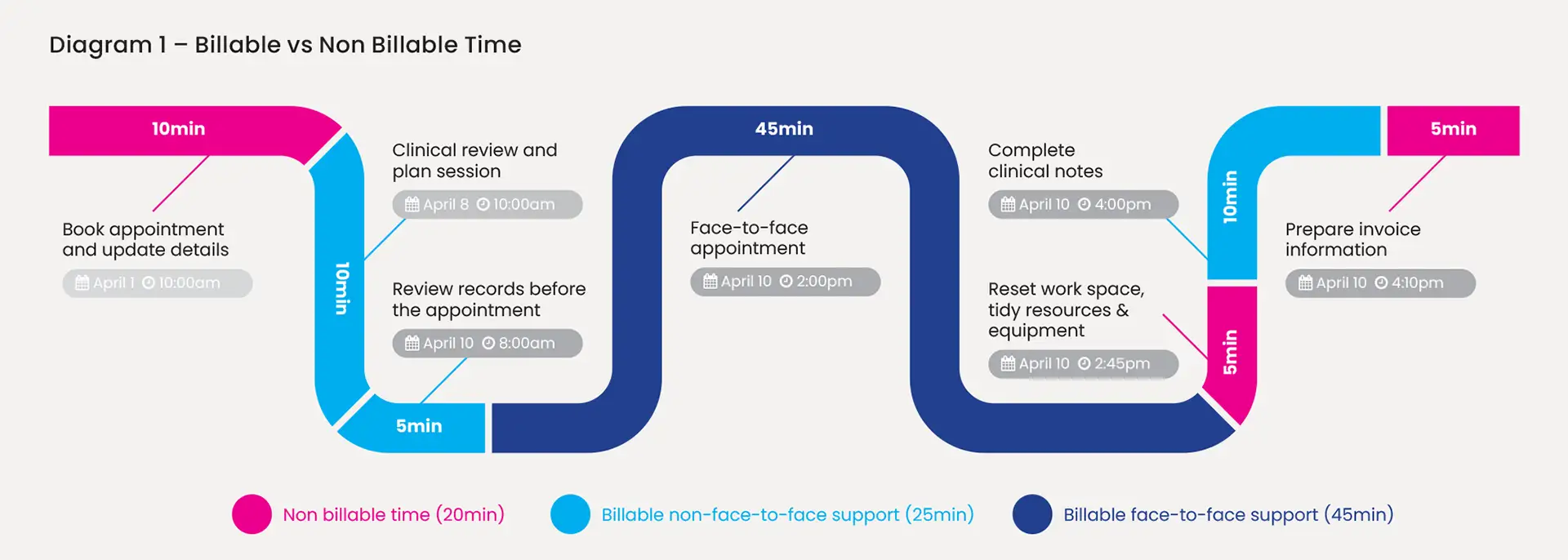
When you book an appointment with us, you are booking more than just the face-to-face time you spend directly with your clinician (for example, in person or via telehealth). Face-to-face time is often the most visible part of your supports, but it is not the only time your clinician spends supporting you.
Your supports are typically an ongoing process, not a one-off appointment. They involve building skills over time, tracking progress, tailoring supports to your goals, and coordinating with others involved in your care. To do this effectively, your clinician will usually spend time before, after, or between appointments providing non-face-to-face supports that are clinically necessary to prepare for, deliver, and follow up on your appointment.
This non-face-to-face time, which we refer to as "preparation and follow-up" (prep & follow-up), may include, for example, reviewing your history and previous sessions, planning and tailoring your appointment, completing clinical notes and records, assessing your progress towards goals, communicating with your family, carers, or other professionals, preparing resources or recommendations, and following up on actions arising from the appointment.
For appointments, you can expect:
- The total time we spend supporting you when providing appointments, and for which you will be billed, may be greater than the face-to-face appointment time
- For appointments with 45 minutes or more of face-to-face time, they will typically require 25 minutes of preparation and follow-up time
- Both face-to-face time and any preparation and follow-up time spent supporting you may be billed as part of your supports
- For appointments intended to have less than 45 minutes of face-to-face time, our clinician can provide you with an estimate of the likely preparation and follow-up time before booking
- You will generally only be billed for the actual time spent delivering supports, unless:
- a short notice cancellation applies; or
- you arrive late or leave early for a scheduled appointment, in which case the full scheduled support may still be charged, or treated as a short notice cancellation, in accordance with the short notice cancellations section of this agreement.
- For peace of mind, for a therapy appointment, you will not be billed for more than 25 minutes of preparation and follow-up unless we provide you with a higher estimate before booking, or you agree otherwise.
- Where we need to travel to provide your supports, travel fees may apply. Travel time is separate to preparation and follow-up and is charged in accordance with the Travel section of this agreement
Appointments connected to assessments and reports
Where an appointment forms part of delivering an assessment or report, the appointment itself may still involve its own preparation and follow-up. This is separate from the additional non-face-to-face work required to complete the assessment or report.
This means that, in these cases, you may see separate charges for:
- the face-to-face time of the appointment;
- the preparation and follow-up for that appointment; and
- the non-face-to-face time required to complete the report or assessment.
Example 1 – Typical Appointment
You book and attend a 45-minute face-to-face appointment. Our clinician spends 10 minutes preparing a session plan, 5 minutes reviewing your file before the appointment, and 10 minutes after the appointment completing clinical notes and tracking your progress towards your goals.
The total preparation and follow-up time is 25 minutes. Together with the 45 minutes of face-to-face time, a total of 70 minutes of supports have been delivered. You are billed for 70 minutes of supports, as expected.
Example 2 – Less time used than typical
You book and attend a 45-minute face-to-face appointment. Our clinician spends 5 minutes reviewing your file before the appointment and 10 minutes after the appointment completing clinical notes and tracking your progress towards your goals.
The total preparation and follow-up time is 15 minutes. Together with the 45 minutes of face-to-face time, a total of 60 minutes of supports have been delivered. You are billed for 60 minutes of supports, being the actual time spent delivering supports. Not the expected 70 minutes.
Example 3 – More time used than expected without agreement
You book and attend a 45-minute face-to-face therapy appointment. Our clinician spends 10 minutes preparing a session plan, 5 minutes reviewing your file before the appointment, and 10 minutes after the appointment completing clinical notes and tracking your progress. The clinician also spends 10 minutes writing you a follow-up email to support your progress, without seeking or obtaining your agreement to exceed 25 minutes of preparation and follow-up.
The total preparation and follow-up time is 35 minutes. Together with the 45 minutes of face-to-face time, a total of 80 minutes of supports have been delivered. However, you are billed for 70 minutes of supports only, as we did not seek or obtain your agreement to exceed 25 minutes of preparation and follow-up for the appointment.
Example 4 – Arriving Late
You book a 45-minute face-to-face appointment scheduled from 10:00am to 10:45am. You arrive at 10:20am.
Your appointment still finishes at 10:45am, as our clinician has other commitments. This means you attended 25 minutes of face-to-face time.
As we have set aside the full appointment time for you, you may still be charged for the full scheduled 45 minutes of face-to-face support time, plus any preparation and follow-up time that has been completed or set aside for the appointment outside of that time. You are not charged twice for the same time.
For example, if our clinician spent 10 minutes preparing for the appointment and had scheduled 10 minutes for follow-up after the appointment, you would be charged for a total of 65 minutes of supports (being 45 minutes of face-to-face time and 20 minutes of preparation and follow-up).
If your late arrival means the purpose of the support cannot be effectively achieved, the support may instead be treated as a short notice cancellation in accordance with this agreement.
Our clinician may use the time while waiting for you to provide appropriate non-face-to-face supports to help keep your supports on track and make best use of the time available.
Example 5 – Cancellation
You book a 45-minute face-to-face appointment. We set aside the appointment time as well as time for preparation and follow-up.
You cancel the appointment with less than two clear business days' notice.
Short notice cancellation fees may apply in accordance with the short notice cancellations section of this agreement. You may be charged for the 45 minutes of scheduled face-to-face time, as well as the preparation and follow-up time that was completed or set aside for that appointment.
If you had provided more than two clear business days' notice, short notice cancellation fees would not apply. However, any preparation and follow-up time that had already been completed before the cancellation may still be charged as supports provided.
Our clinician may use the cancelled time to provide appropriate non-face-to-face supports to help keep your supports on track and provide value.
13. Assessments and reports
Assessments involve gathering and interpreting information about you, including forming clinical opinions and conclusions, and may involve preparing a formal written document. This may require one or more appointments (for example, observation, testing, interviews, or other clinical activities). Some assessments, such as functional capacity assessments, involve a substantial written report as part of the overall support.
Reports are written documents that may be prepared as the outcome of an assessment, or to document, analyse, or provide conclusions about aspects of your circumstances, progress, or supports, often for a specific purpose or audience. Not all reports require a face-to-face component. In some cases, a report may be completed using existing information without an additional appointment.
Unless we tell you otherwise, you should assume that an assessment will usually involve a report, and that a report will usually require an assessment. Any appointments booked for the purpose of an assessment or report form part of that broader support and are not therapy appointments.
When you request an assessment or report, we can provide you with an estimated total billable time. This estimate includes all work required to deliver the support, based on your circumstances and the intended purpose and scope at the time of quoting.
Assessments and reports can vary in complexity. As a result:
- we cannot guarantee that the support will be completed within the estimated time; and
- our clinicians will aim to stay within the estimate, but this is not always possible
If additional information, complexity, or changes to scope arise, we may revise the estimate and seek your agreement before continuing. Fees apply for all time spent providing supports.
If you do not agree to additional time or fees:
- we may suspend or stop the work
- we may decline to provide the support
- at our discretion, we may complete the work and limit charges to the originally estimated time
Assessments and reports are prepared based on the information available to us at the time and for the purpose for which they were requested. You agree to provide complete and accurate information, and acknowledge that incomplete or incorrect information may affect accuracy, findings, outcomes, recommendations, and the time required.
We do not guarantee that an assessment or report will meet the requirements of any third party (such as the NDIA, schools, courts, or other organisations). If a different purpose is required, or amendments beyond minor corrections are needed, additional fees may apply.
Our clinicians exercise independent professional judgement when preparing assessments and reports. Findings, recommendations, and conclusions cannot be guaranteed. You may request a review of an assessment or report, which will be undertaken by a senior clinician; the outcome of that review is final.
We may require payment before releasing an assessment or report. This means we may withhold the document until all outstanding fees relating to that work have been paid.
If you have any concerns about timeframes or costs, we encourage you to discuss these with us as soon as possible.
14. NDIS Progress Reports
If you are an NDIS participant, progress reports may be required as part of your supports. These are commonly needed before the end of your NDIS plan, or at intervals during your plan (for example, every 6 to 12 months), depending on your circumstances and plan requirements.
Where a progress report is anticipated, we may set aside part of your available funding for this purpose as part of planning your supports.
We will tell you when we consider that a progress report is required, and you can also ask us to prepare one. In either case, we will confirm whether the report is appropriate for your circumstances and provide an estimate of the expected time and cost before proceeding.
Typically, a progress report takes around one hour of therapist time and is billed at the applicable support rate.
Progress reports and other NDIA-requested reports are a standard and necessary part of delivering supports under the NDIS. They are used to document your progress, assess what is working and what may need to change, and provide evidence to support your ongoing or future funding. Quality providers use this process to help keep your supports effective and aligned with your goals.
Where we consider that a progress report is required, it forms part of the supports we provide to you and will be completed and billed accordingly.
If you do not wish to proceed with a progress report that we consider necessary, we may not be able to continue providing supports, as this may prevent us from meeting our professional, clinical, or funding obligations.
15. Travel
When planning your supports, we will consider whether travel is reasonably necessary, or whether similar or better outcomes can be achieved more cost-effectively in-clinic or via telehealth, consistent with the requirements of many funding arrangements. We will generally not undertake travel where it is primarily a matter of preference.
We aim to schedule supports to minimise travel time and costs where reasonably possible. We will work with you to determine the most appropriate and cost-effective way to deliver your supports.
Where we are required to travel to provide supports to you, such as at your home or in the community, we may charge for travel time and travel costs. Travel charges are subject to any applicable funding arrangements, including any caps, limits, or conditions that apply.
Travel time (Provider Travel – Labour Costs (Time)):
This is the time our clinician spends travelling to and from your support location. This may include travel to your appointment from a prior location and return travel, where applicable.
Travel time is charged at our standard base rate for the clinician delivering your supports, unless otherwise required by applicable funding arrangements, pricing rules, or agreed rates.
Travel costs (Provider Travel – Non-Labour Costs):
This includes the non-labour costs associated with travel to deliver supports. This may include:
- $1.00 per kilometre travelled when we use a vehicle owned by us or our clinician.
- the full cost of other forms of transport and associated costs, such as road tolls, parking, flights, public transport fares, and facility hire.
Estimates
If you would like an estimate of travel time or travel costs for your supports, please contact our coordination team.
Apportioning of travel
Where our clinician travels to provide supports to more than one participant within a 'region', travel time and travel costs may be apportioned between the participants receiving supports. The manner of apportionment will be agreed with you in advance.
16. Rescheduling Supports
Sometimes we may need to reschedule your supports, including appointments. This might happen where we need to prioritise another participant's urgent needs, or where we're unable to reasonably provide the support at the scheduled time, for example due to clinician leave, illness, or facility availability.
You can also ask to reschedule your supports at any time by contacting our coordination team.
If a support is cancelled or rescheduled, we can't guarantee it will be rebooked at your preferred time or without delay. This may be due to limited availability or circumstances outside our reasonable control.
Please also see the section of this agreement about short notice cancellations.
17. Key worker for Early Childhood Early Intervention (ECEI)
If you would like a key worker for an ECEI participant, please contact our coordination team. We will review your needs and suggest suitable clinicians from our team to act as your key worker. Please note that fees apply for key worker supports.
18. Payment
You must pay for supports on the day they are provided, unless your invoice states otherwise. Payments can be made at our clinic reception by card, cash, EFT (bank transfer), or any other method we accept.
If your supports are funded by a third party, you authorise us to claim or seek payment from that funder on your behalf where applicable.
If payment is not made when due for any reason, we may suspend or stop providing supports until the outstanding amount is paid.
If you are an NDIS participant:
- You authorise us to claim payment from your NDIS plan for supports we provide, in accordance with this agreement and applicable NDIS rules.
- If your supports are self-managed, you pay us directly.
- If your plan is NDIA-managed, you must add or endorse us as a provider in the NDIS system so we can claim payment for supports we deliver.
- If you are plan-managed, we will invoice your plan manager for payment. We may ask your plan manager to confirm that you have sufficient funding for the supports you have requested.
19. What if your funder doesn't pay? (e.g. NDIS, insurance, or Medicare)
You remain responsible for paying for all supports provided to you by us, including any applicable cancellation fees.
We will take reasonable steps to claim or seek payment from your funding source where applicable. However, if payment is not made for any reason, you agree to pay the outstanding amount.
20. When does this service agreement end?
This service agreement has no set finish date. You can end this agreement by telling our coordination team. We can end this agreement with the approval of one of our directors.
Ending this agreement does not affect any amounts already owed. You must still pay for any supports already provided, and any applicable cancellation fees.
If you are an NDIS participant, you authorise us to claim these amounts from your NDIS plan and any related service bookings.
21. What if you need something after this agreement ends?
If you request supports from us after this service agreement ends, any supports we agree to provide will be delivered under the service agreement in effect at that time.
22. Updates to this service agreement
We may update this service agreement from time to time.
The current version is always available on our website and applies to the supports we provide, unless we agree otherwise with you.
If we make material changes, we may take reasonable steps to let you know. This will usually involve us sending you an email to let you know that a new version is available on our website.
By continuing to request or receive supports from us after an updated version takes effect, you agree to the updated version.
23. Our directions
You agree to comply with and abide by all reasonable directions given by our team and representatives.
24. Other things you have to tell us
You need to tell one of our coordinators or a clinician anything that could affect how we support you.
This includes giving us all information we reasonably need to provide safe and effective supports, such as relevant health information, risks, behaviours, or changes in your circumstances, and telling us about anything that could affect your safety, our team, or other people.
You also need to give us accurate and up-to-date information about how your supports are funded, and anything that affects our ability to charge for and receive payment for those supports. For example:
- details of your NDIS plan, service bookings, budgets, and funding periods (including any changes)
- any Medicare, private health insurance, or other insurer arrangements relevant to your supports
- third party funding arrangements (such as schools, employers, or other organisations), including any approvals, limits, or conditions
- any referral requirements or other conditions that apply to your supports, where relevant
- any changes to your funding, eligibility, or claim status
If you do not provide this information, or if it is incomplete or inaccurate, we may not be able to provide supports, or we may need to charge you directly for those supports.
You also need to tell us if your contact details change.
25. Emergency, Disaster, and Disruption
If our services are disrupted, we will try to reschedule your supports to maintain continuity of care. Sometimes this is not possible, or delays may occur, particularly where the disruption is caused by events outside our reasonable control.
26. Intellectual Property
All intellectual property created by us, or otherwise owned by us, remains our exclusive property. You do not acquire any rights, title, or interest in our intellectual property.
To the extent permitted by law, we may withhold access to assessments, documents, files, records, reports, and other information where we consider it appropriate, including where you have unpaid fees or charges.
27. Consent to contact
We may contact you, and other people involved in your care (such as your family, carers, referrers, support coordinator, GP or plan manager), by phone, SMS, email, letter, or other reasonable methods.
We may do this to communicate about matters related to your supports, care, and our services, including sending service-related communications and other information connected with your relationship with us.
This consent continues until you tell us not to contact you or a particular person. However, we may still contact you or that person if required or permitted by law, if there is a risk to someone's health or safety, or where reasonably necessary to meet our professional, clinical, funding, or legal obligations.
We may also contact you about service disruptions, emergencies, or disasters, even if you are no longer a participant or have asked us to limit contact.
28. Consent to marketing
You consent to us sending you marketing and promotional communications by phone, SMS, email, or other reasonable methods. You can opt out of marketing communications at any time by following the instructions in the communication or by contacting our coordination team.
29. Privacy
We collect, use, store and disclose your personal information (including health and sensitive information) to provide supports to you and operate our services.
What we collect
We may collect information such as:
- your name, contact details, and date of birth,
- NDIS, Medicare or other funding information,
- health, therapy, medical records, and assessment information,
- reports, progress notes and correspondence,
- billing and payment information,
- information about your family, carers, referrers, and support network.
We only collect information that is reasonably necessary to provide supports or to meet our legal and regulatory obligations.
Your information may be stored in both electronic and physical forms. This includes storage within our systems and devices, and in data centres located in Australia within Halaxy, our Microsoft 365 environment, MYOB, and encrypted backup systems hosted in Amazon Web Services (AWS). We take reasonable steps to protect your information and keep it subject to Australian privacy laws.
We may also provide your information to other third-party service providers where reasonably necessary to operate our services. These providers are required to comply with privacy and confidentiality obligations.
We take reasonable steps to protect your information from misuse, interference, loss, unauthorised access, modification or disclosure.
How we use and disclose your information
We use your information to:
- provide supports and manage your care
- communicate with you and those involved in your supports
- prepare reports, invoices, and funding claims
- meet our obligations under the NDIS, Medicare, insurance schemes or other funding bodies
- comply with legal, regulatory or safety requirements
- quality assurance and improvements of our services and operations
We may disclose your information to referrers, carers, GPs, allied health professionals, plan managers, the NDIA, insurers or other relevant parties involved in your supports, unless you tell us otherwise. Even if you ask us not to disclose information, we may still do so where required or permitted by law, or there is a risk to someone's health or safety, or to meet our professional, clinical, funding, or legal obligations.
Access and correction
You may request access to, or correction of, your personal information by contacting our coordination or quality management team. We will respond in accordance with the Privacy Act 1988 (Cth).
In some circumstances, we may need to limit access or decline to make a requested correction, for example where this is required or permitted by law, or where providing access or making the change could pose a risk to you or another person, or where the information is not inaccurate. In these cases, we will take reasonable steps to explain our decision and, where appropriate, note your request on the record.
If you have questions about how we handle your information, or if you would like to withdraw or limit a consent (where legally and reasonably possible), please contact our coordination team. Please note that withdrawing or limiting consent may affect our ability to provide supports to you.
By requesting or receiving supports from us, you consent to the collection, storage, use and disclosure of your information as described in this agreement.
30. AI
We use AI-assisted tools across our services to support efficiency, accuracy, and clear communication. These tools support our work but do not replace clinical judgement, professional decision-making, or responsibility for your care.
You consent to us using AI-assisted tools as part of providing supports to you. The AI-assisted tools we may use include various AI-assisted technologies, including Heidi and Microsoft 365 Copilot. AI is integrated into our systems and cannot reasonably be separated.
Heidi
Heidi is an AI-assisted transcription tool that we may use to transcribe conversations and prepare clinical notes from our interactions with you, including in-person appointments, phone calls, video calls, and online interactions.
Audio from your interactions with us is transmitted securely to Heidi for immediate transcription and is not retained once transcription is completed. Heidi complies with the Australian Privacy Principles and the Privacy Act 1988 (Cth). All data is encrypted and stored in Australia, and Heidi's information systems are ISO 27001-certified for data security.
Microsoft 365 Copilot
Microsoft 365 Copilot is an AI assistant and generative AI tool that we may use to assist with drafting, editing, proofreading, researching, summarising information, and supporting communication, documentation, and administrative tasks.
Copilot operates within an enterprise-grade data protection framework, which means that:
- all information remains within our Microsoft 365 tenant and is not publicly accessible
- your data is protected by Microsoft's Enterprise Data Protection standards, including strict access controls
- data is stored at rest in Australia under Microsoft's Advanced Data Residency program and protected by Australian privacy laws
- your data is not used to train AI models
Copilot may use Microsoft's Bing search service to obtain up-to-date information. This may involve transmitting limited information, in the form of search queries, to Microsoft for that purpose. Microsoft has committed that these queries are used only to provide the service, are not used to train AI models or improve Bing, and are treated as customer confidential information.
You must tell us at the time you request a support if it is intended for submission to a court or for use in legal proceedings. You acknowledge that preparing supports without AI may take longer, that this additional time will result in additional fees and may require a revised quote, and that delivery timeframes may be extended or, in some cases, the support may not be able to be provided.
Security
We may use AI-assisted tools to support the security of our systems and the information we hold about you.
This may include using AI-assisted technologies to identify, filter, and prevent malicious or harmful activity, such as spam, phishing emails, suspicious files, or other cybersecurity threats.
As part of this process, these tools may scan files that contain your information and communications you send to us. These tools do not store this information or use it for any purpose other than supporting the security of our systems and services.
These tools help us protect our systems, our team, and your information, and form part of our broader approach to maintaining a secure and reliable service environment.
31. Surveillance Cameras
You consent to the use of video surveillance cameras in and around our clinics. These record video only (not audio) and are used for safety, security, and quality.
32. Governing Law
33. Feedback, Complaints, and Disputes
It is important to us that you feel comfortable and supported in providing us with feedback, making complaints, and seeking solutions to disputes. You can give feedback or make complaints by contacting our coordination team or our quality management team.
Our coordination and quality management teams have the authority to discreetly discuss matters if you wish your feedback or concerns to remain anonymous or not be relayed to another team member.
If you are still not satisfied or do not wish to speak with our team, you can contact the Office of the Health Ombudsman in Queensland online at oho.qld.gov.au or by calling 133 OHO (133 646). If you are an NDIS participant, you can also contact the NDIS on 1800 800 110, by visiting one of their offices, or online at ndis.gov.au.
34. Contact Information
If you need to get in touch, here are the best ways to contact our teams:
Coordination Team
Call (07) 4772 1219 and ask for "Coordination"
Email: coordination@allianceclinics.com.au
Quality Management Team
Call (07) 4772 1219 and ask for "Quality Management"
Email: feedback@allianceclinics.com.au
Post: PO Box 2024, Townsville QLD 4810, addressed to "Alliance Clinics Quality Management"
Published Dates
SSSA 2026-07-01 – [Int Ref FO.QA Approved Service Agreement Wording]
Update:
- Changes relating to the price of supports provided under the NDIS, to be in line with the updates released by the NDIA which came into effect on the 1st July 2026
SSSA 2026-05-05 – [Int Ref FO.QA.0029 Approved Service Agreement]
Comprehensive update:
- Broad revisions and improvements across the agreement
SSSA 2025-09-22 – [Int Ref FO.QA.0029 Approved Service Agreement]
Comprehensive update:
- Broad revisions and improvements across the agreement
SSSA 2025-06-20 – [Int Ref FO.QA.0029 Approved Service Agreement]
Added:
- New clause: Other things you have to tell us
- New clause: Consent to contact
- New clause: Governing Law
Reordered.
SSSA 2024-06-18 – [Int Ref FO.QA.0029 Approved Service Agreement]
Added:
- New clause: Key Worker
- New clause: Emergency, Disaster, and Disruption
Reordered.