

A Simple Guide for GPs Managing Eligible Disability Presentations
Medicare M10 Pathway
Children & young people under 25 years may be eligible for Medicare-funded allied health assessment & treatment services under the M10 pathway.
Importantly, for eligible disabilities, a GP can refer directly to allied health without waiting for paediatrician review.
This pathway helps reduce delays to therapy, supports earlier intervention, & allows allied health assessment to assist clinical decision-making & treatment planning.
Patient Eligibility
Your patient must be under 25 years of age to access:
- allied health Medicare Benefits Schedule (MBS) items
- for assistance in diagnosing the patient or contributing to a treatment plan
- a treatment & management plan prepared by a specialist, consultant physician or general practitioner
allied health MBS items for treatment services
Key Point for GPs
You can refer directly for eligible disabilities.
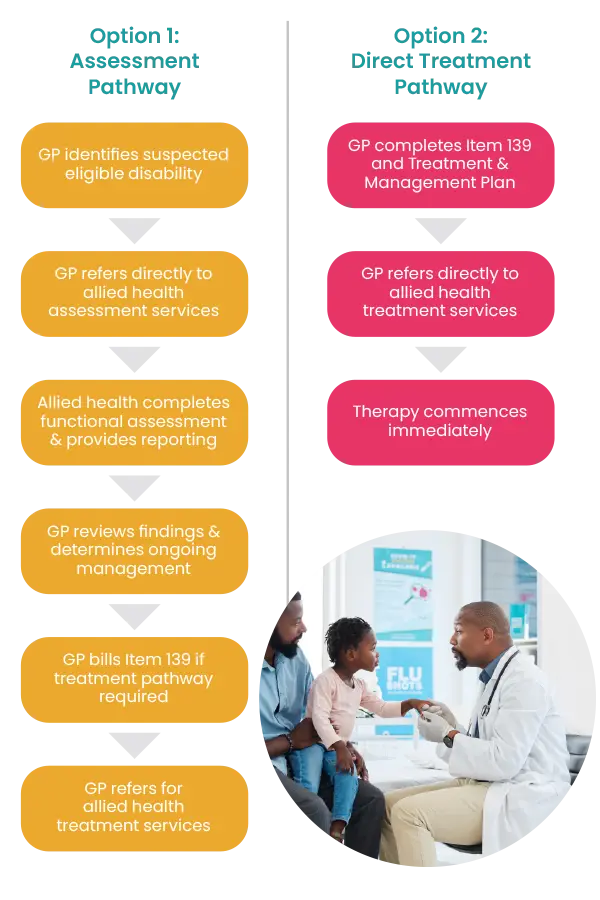
For eligible disability presentations, a GP can:
- assess eligibility
- refer directly to allied health for assessment services
- use allied health assessment to support diagnostic clarification & functional profiling
- initiate treatment services once Item 139 & a Treatment & Management Plan are completed
You do not need to wait for paediatrician involvement for eligible disability pathways.
What the M10 Pathway Is NOT
The M10 pathway is:
- NOT a GP Management Plan (GPMP)
- NOT a Chronic Disease Management Plan
- NOT limited to paediatricians
- NOT a generic developmental referral pathway
For complex neurodevelopmental conditions such as autism assessment, referral requirements differ & usually require paediatrician or psychiatrist involvement.
Eligible Disabilities Include
Examples of eligible disabilities include:
- Cerebral palsy
- Down syndrome
- Fragile X syndrome
- Prader-Willi syndrome
- Williams syndrome
- Angelman syndrome
- Kabuki syndrome
- Smith-Magenis syndrome
- CHARGE syndrome
- Cri du Chat syndrome
- Cornelia de Lange syndrome
- Rett syndrome
- Microcephaly associated with significant functional impairment
- Hearing impairment
- Deafness
- Vision impairment
- Blindness
- Deafblindness
- Fetal alcohol spectrum disorder (FASD) with an IQ of less than 70 on a standardised test of intelligence
- Cleft lip and/or palate
- Stuttering
- Speech sound disorders, including:
- Articulation disorder
- Phonological disorder
- Childhood apraxia of speech (CAS/dyspraxia/developmental verbal dyspraxia/speech apraxia)
- Dysarthria
Patients must experience significant functional impairment related to the eligible disability.
Assessment vs Treatment Services
| Assessment Services | Treatment Services |
|---|---|
| Can occur BEFORE Item 139 | Require Item 139 |
| Focus on assessment & functional profiling | Focus on therapy & intervention |
| Assist diagnostic clarification | Deliver ongoing treatment |
| Support GP decision making | Support functional improvement |
Allied Health Services Available
| Allied Health Discipline | Assessment Item | Treatment Item |
|---|---|---|
| Psychology | 82000 | 82015 |
| Speech Pathology | 82005 | 82020 |
| Occupational Therapy | 82010 | 82025 |
| Physiotherapy, Audiology, Orthoptics, Optometry, Dietetics, Exercise Physiology | 82030 | 82035 |
Billing Structure
| Service | Requirement | Service Limits |
|---|---|---|
| Allied Health Assessment Services | GP referral only | Up to 8 services lifetime |
| Allied Health Treatment Services | GP must bill Item 139 & prepare a Treatment & Management Plan | Up to 20 services lifetime |
Important Billing Notes
- Prior to Item 139, GPs may use standard GP attendance items while undertaking assessment, developmental review, diagnostic clarification, & care planning.
- Assessment services can occur before Item 139. Referral for assessment is a simple request on GP letterhead. No special form is required.
- Allied health assessment can assist the GP in confirming diagnosis & informing the Treatment & Management Plan.
- Treatment services require the GP to bill Item 139 & prepare a Treatment & Management Plan.
- Up to 20 allied health treatment services are available across the patient’s lifetime.
- Allied health providers must provide written reporting back to the referring GP after 4 assessment sessions & after 10 treatment sessions.
Why it Matters
The M10 pathway allows:
- earlier therapy access
- reduced wait times
- improved functional assessment
- better treatment planning
- multidisciplinary support before specialist review where appropriate
For many children and young people, this can significantly reduce delays to intervention and functional support.
Further Information
Services Australia Requirements of services for complex neurodevelopmental conditions and eligible disabilities – Health professionals – Services Australia
MBS Online Item 139 | Medicare Benefits Schedule
Department of Health Fact Sheets Medicare M10 services for complex neurodevelopmental conditions and eligible disabilities | Australian Government Department of Health, Disability and Ageing